Open-source engineering

Unchair: a local-first macOS tool for people who sit too long

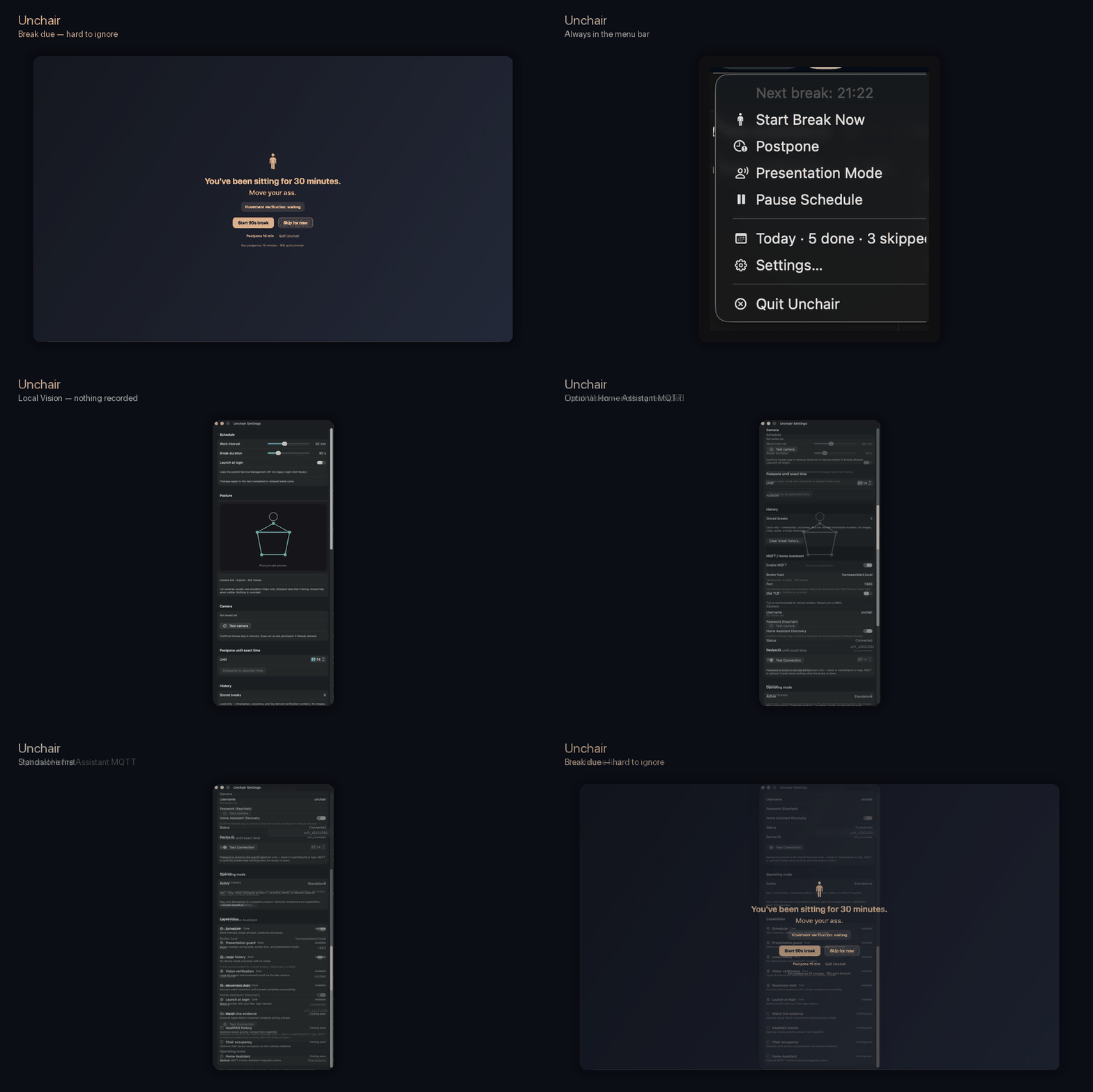
Unchair is an open-source macOS app by Étienne Deneuve, CTO of Omnivya. It reminds people to move, can verify a sit-to-stand locally with Apple Vision, ships a privacy-safe Human Runtime weekly card from local history only, stays out of meetings, and does not need an account or cloud service to do its job.

Homebrew

One-command install from the dedicated tap

brew install --cask EtienneDeneuve/unchair/unchair
local-first / macOS
Unchair product tour on macOS

Why we publish it

It is a small app, but it touches subjects we deal with every day: state, failure modes, privacy, integrations, observability and software distribution. The repository is public, so the implementation can be checked instead of taken on faith.

01

Local-first architecture

The core experience does not require an account, backend, network connection or Home Assistant. Camera frames and Vision landmarks stay in-memory and are not persisted or uploaded. The Human Runtime weekly card is rendered from on-device history only.

02

Deterministic behavior

Break due, postpone, presentation deferral and movement verification are explicit domain states rather than loosely coupled UI events.

03

Safe integration boundaries

Home Assistant is optional. MQTT exposes derived state and a narrow command allowlist; remote systems cannot mark movement as verified.

04

Operational visibility

Optional OpenMetrics/Prometheus and tracing expose the runtime without turning observability into a cloud dependency.

05

Release engineering

macOS builds are Developer ID signed, notarized and stapled, distributed as DMG/ZIP and a first-class Homebrew Cask, with Sparkle-compatible update metadata. Public releases are currently at 0.4.0.

06

Product restraint

The app deliberately avoids medical claims, posture scoring, cloud identity and employee-surveillance positioning.

Workplace wellbeing

A break tool for employees, not an employee-monitoring tool

For companies with people spending most of the day in front of a Mac, Unchair can be offered as a voluntary wellbeing and ergonomics tool: reduce long uninterrupted sitting periods, encourage regular movement, and make breaks harder to dismiss.

Read the practical workplace wellbeing note from My Dare (FR) ↗

Voluntary by design

The useful model is opt-in: give employees a tool they control instead of turning movement into another HR KPI.

No posture score

Unchair does not diagnose posture, health or fitness. It detects enough local movement to validate a break, nothing more.

No manager dashboard

There is no built-in employee ranking, attendance score or central surveillance view. Core data stays on the user’s Mac.

Works with real work

Presentation and call signals defer interruptions, and idle/lock periods pause desk-time tracking instead of generating nonsense.

Technical surface

SwiftSwiftUIAVFoundationApple VisionXCTestNetwork.frameworkmacOS KeychainHomebrew CaskMQTTOpenMetricsOpenTelemetry

The pattern we care about

Unchair is small enough that the trade-offs are easy to inspect: what stays local, what counts as evidence, what happens when an integration is down, and what an external system is allowed to control.

The code is public. The app is installable.

Unchair is free, MIT-licensed and available for macOS 14+ (public release 0.4.0). The privacy model, release path and integration contracts are documented in the repository.